By the middle of a long workday, your body can start to feel strangely unfamiliar.
You haven't done anything strenuous. You've probably spent most of the morning answering emails, looking at a screen, sitting through meetings, or working at a keyboard. Yet your hips feel tight, your shoulders are creeping upward, and your upper back seems to have forgotten what standing tall feels like.
That experience is common among people who spend much of their working life at a desk. It doesn't necessarily mean something is wrong, and it doesn't mean you need another demanding workout. Often, what has been missing is simply movement.
Mobility exercises for desk workers offer an easy way to bring some variety back into the day. They take your joints through comfortable ranges of motion and can be done in short breaks, at home, or alongside a regular exercise routine. Some take less than a minute.
The idea isn't to "undo" sitting or force your body into extreme stretches. It's much simpler: give your neck, shoulders, spine, hips, and ankles some movement after they've spent a long time doing very little.
Why sitting can leave you feeling stiff
The problem with desk work isn't that the human body has a single forbidden posture. People can sit, stand, lean, slouch, stretch, and change positions in all sorts of ways.
The trouble tends to come when one position becomes the default for hours.
Think about a normal workday. You sit down for the first meeting, stay there to answer messages, eat lunch at your desk, settle back in for another meeting, and perhaps spend the evening sitting again. Even someone who exercises regularly can accumulate a lot of time with very little movement between workouts.
Changing positions gives your body something different to do. Your joints get to move, your muscles have to work in different ways, and you're no longer asking the same areas to stay relatively still for quite so long.
There's also a useful distinction between mobility and flexibility.
Flexibility is generally about the amount of movement available around a joint or through a group of tissues. Mobility goes a little further, because it also involves your ability to control that movement.
That difference matters for desk workers. A long-held stretch is one option, but it isn't the only one. Rotating your upper back, moving your hips through different positions, or gently turning your neck can all introduce movement that isn't part of ordinary keyboard-and-screen work.
The exercises worth having in your desk-mobility toolkit
You don't need a complicated routine or a separate exercise for every muscle in your body. A small selection that covers the neck, shoulders, upper back, hips, and ankles is plenty to begin with.
Chin tucks
Hours of screen time can leave your head sitting farther forward than it feels when you're standing and moving around.
A chin tuck gives you a chance to reverse that position gently. Sit or stand comfortably, keep your eyes looking straight ahead, and draw your chin backward without tipping your head up or down. You should feel a small movement rather than a dramatic stretch.
The range can be surprisingly modest. That's fine. Several relaxed repetitions are enough to explore the movement.
If it produces pain, dizziness, numbness, or anything that feels unusual, there's no benefit in forcing it.
Neck rotations
Your head doesn't get many opportunities to turn when you're focused on a screen.
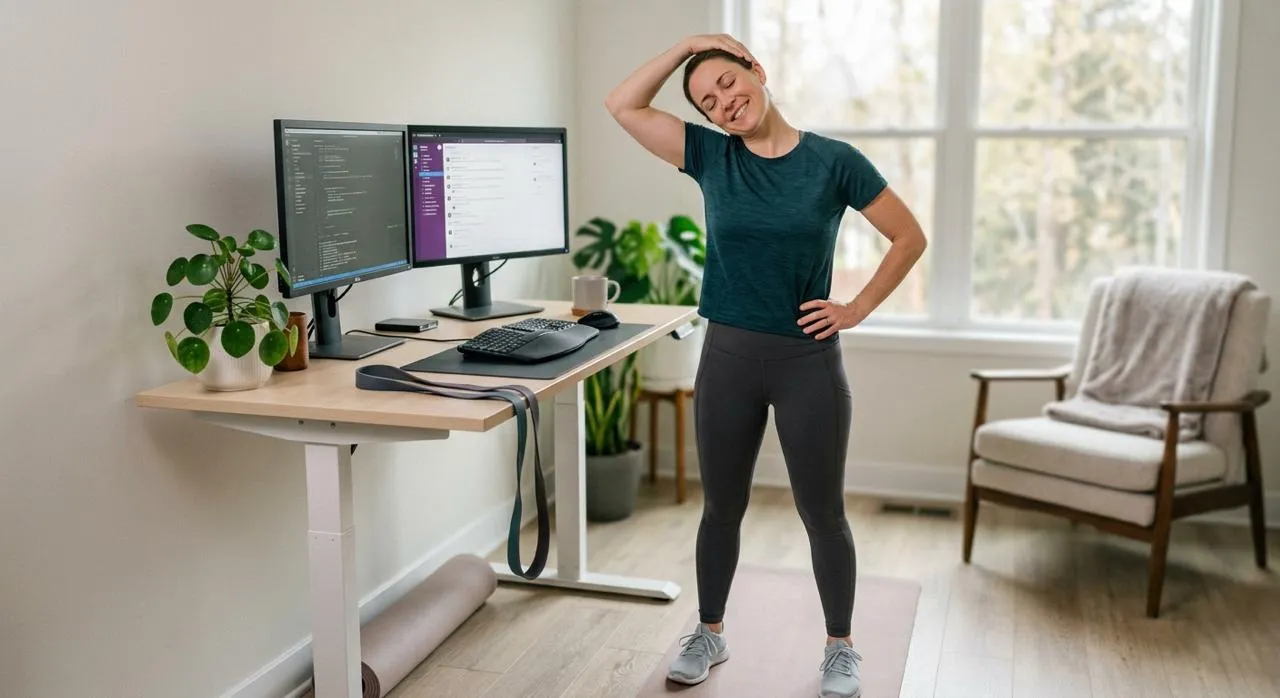
Slowly rotate your head toward one side and stop at a comfortable point. Come back to the middle, then turn the other way. Let your shoulders stay relaxed while you move.
There isn't a particular angle you have to reach. Your range may also feel different from one side to the other.
Keep it easy and controlled rather than making quick circles with your head.
Shoulder rolls
Sometimes the simplest movements are the ones that actually survive a busy workday.
Let your shoulders rise gently, move them backward, and settle them down again. A few slow circles can feel noticeably different after a stretch of typing or mousing.
You can change direction after several repetitions, or simply raise and lower the shoulders if that feels better.
The goal isn't to make the biggest possible circle. It's to give the shoulders a movement they haven't had while you've been concentrating on the screen.
Wall slides
Wall slides are useful when you have a little more room and want to give your shoulders and upper back a different movement experience.
Stand with your back against a wall if that feels comfortable. Bring your arms into a relaxed goalpost position and slowly move them upward before bringing them back down.
Don't worry if your arms don't travel very far. Someone who is new to the movement may have a much smaller range than someone who has practiced it for years.
What matters more is that the movement feels controlled and comfortable. If your shoulders become uncomfortable near the top, stay below that point.
Open books
Desk work keeps the upper body facing forward for much of the day. The open-book movement introduces some gentle rotation without requiring you to stand.
Lie on your side with your knees comfortably bent and your arms together in front of you. Slowly open the top arm and allow your chest to turn with it. Pause briefly if that feels comfortable, then return to the starting position.
The knees can stay relatively still while the upper body does the moving.
This one is probably better suited to home than to an office break. If getting down onto the floor would require rearranging half the workplace, save it for later.
Seated thoracic rotations
A chair can be enough when you want to move your upper back during the workday.
Sit with both feet supported. Cross your arms over your chest, or place your hands lightly behind your head, and turn your torso toward one side. Come back through the middle and rotate in the other direction.
The movement doesn't have to be large. You're simply giving your spine a chance to rotate after spending time facing forward.
Because it requires almost no setup, this is an easy one to fit between meetings.
Cat-cow
Cat-cow moves the spine through a gentle sequence of rounding and extension.
Start on your hands and knees, then slowly round your back before moving in the opposite direction. Let the chest and pelvis change position along with the spine rather than trying to isolate one tiny area.
Neither end needs to be extreme. Smooth movement matters more than achieving a dramatic arch or curve.
If you're at work and don't fancy getting onto the floor, try a seated version instead. From your chair, gently round your back and then move toward a more extended position.
Hip flexor stretch
When you're seated, your hips remain bent for a long time. A gentle hip flexor stretch can be a useful change, particularly if the front of your hips often feels tight after work.
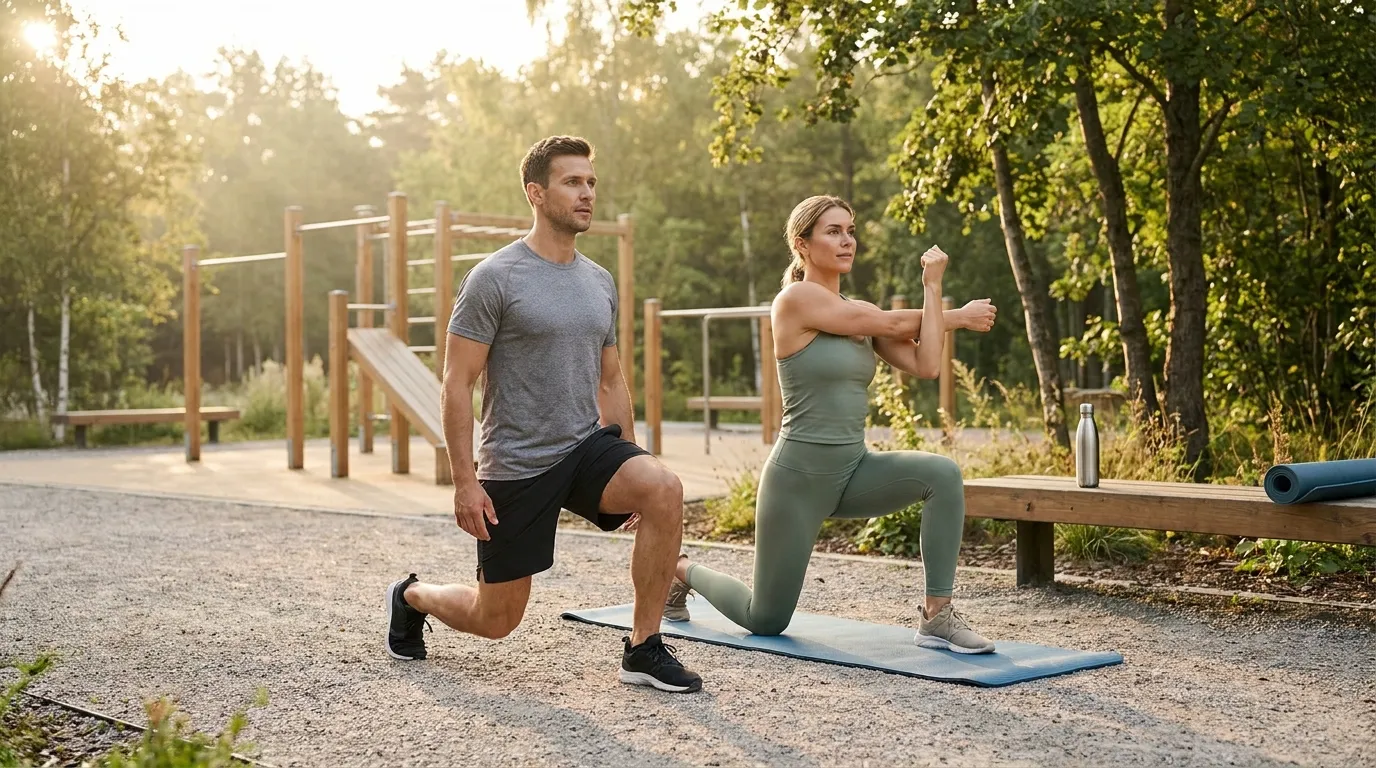
One option is a half-kneeling position. Place one knee on a comfortable surface and put the opposite foot in front of you. Stay fairly upright and shift forward gently until you notice a stretch around the front of the hip of the kneeling leg.
It doesn't need to be intense.
If you find yourself arching your lower back to get farther into the position, back off a little. A standing version works well when floor space isn't available.
90/90 hip rotations
The hips can move in several directions, although a desk chair doesn't ask for much of that variety.
A 90/90 position explores hip rotation. Sit on the floor with your knees bent and your legs arranged so one hip is rotated inward while the other rotates outward. From there, move the legs from one side toward the other as far as you can control comfortably.
This may feel awkward if you're new to it. That's not a problem.
Use your hands for support if you need them, and don't worry about making your knees reach the floor. The movement itself is more relevant than achieving a particular shape.
Ankle rocks
Your ankles may be easy to forget, especially when most of your workday happens with your feet underneath a desk.
Stand facing a wall with one foot slightly forward. Keep the front heel down as the knee moves gently toward the wall, then return.
The foot should stay reasonably stable rather than collapsing inward as the knee travels.
A few repetitions on each side are easy to fit into a standing break. Simple calf raises are another option if you want to get the lower legs moving after sitting.
What a realistic five-minute break might look like
You don't have to work through every exercise in this article.
On a busy day, a few neck rotations, chin tucks, shoulder rolls, seated upper-back rotations, ankle rocks, and a standing hip flexor stretch could be enough to give you a change of position.
On a quieter day, perhaps you have time for some wall slides or floor-based work.
The right mix depends on what your day actually looks like. Someone who spends eight hours leaning toward a laptop may naturally gravitate toward upper-back and shoulder movements. Someone who rarely gets out of their chair might benefit more from simply standing, walking, and moving the hips and ankles.
Your mobility routine doesn't have to be identical every day.
How often should desk workers do mobility exercises?
There isn't a magic number of minutes that everyone needs.
For someone at a desk all day, short movement breaks can be more practical than saving all your mobility work for one long session. A couple of minutes after a meeting, a walk before lunch, or some shoulder movement while waiting for your computer can all interrupt a long period of sitting.
Those moments don't need to become formal workouts.
If you already train, mobility can also fit into the beginning or end of your session. On days when you're short on time, a few targeted movements may be all you manage.
That's okay. The routine has to fit the day you're actually living, not the perfectly organized day that exists on paper.
Mobility isn't a substitute for exercise
Mobility work has a useful but limited job.
It gives your body opportunities to move through different positions and breaks up some of the stillness that comes with desk work. It doesn't replace walking, strength training, cardiovascular exercise, sport, or other forms of physical activity.
Ten minutes of mobility can't turn an otherwise inactive day into an active one.
But that doesn't make ten minutes meaningless. A short mobility break, a walk between meetings, an evening workout, and a few more changes of position throughout the day can all add up to a more varied pattern of movement.
Think of mobility as one piece of that picture rather than the whole solution.
Mobility and stretching aren't quite the same thing
The two terms overlap, which is why they're often used as though they mean the same thing.
Static stretching usually means holding a muscle or joint in a lengthened position for a period of time. Mobility work tends to involve more active movement and control through a range.
Consider the hips. A standing hip flexor stretch keeps you in one position while you feel a stretch across the front of the hip. A hip rotation exercise asks the joint to move through several positions instead.
Neither approach has to win.
A gentle stretch might feel good after sitting. Controlled movement may be more appealing when you're trying to wake up an area that's been still. Before exercise, dynamic movements and a gradual warm-up are often a natural fit; at other times, holding a comfortable stretch may suit you perfectly well.
What matters is matching the type of movement to what you're trying to do.
A few common mistakes
Trying to build the perfect routine
It's tempting to collect exercises until your five-minute break has somehow become a 40-minute mobility session.
More isn't automatically better. If six movements fit naturally into your day, there's little reason to add another fourteen simply because they're available.
Treating discomfort as proof that it's working
Mobility doesn't have to hurt.
A mild stretch or a sense of muscular effort can be normal, but sharp pain, significant joint pain, numbness, tingling, dizziness, or other unusual symptoms aren't sensations to chase.
More range isn't necessarily better range.
Trying to match someone else's range
Bodies aren't built from identical measurements. Hip structure, proportions, training history, and previous injuries can all affect how a movement looks.
A 90/90 position that appears effortless in a demonstration might be challenging for someone else. That's not a failure. The useful range is the one you can control comfortably.
Rushing through the movements
There's not much point in turning mobility into a speed challenge.
Slower movement gives you time to notice how a joint feels and where your comfortable range ends. It also makes it easier to change the movement if something doesn't feel right.
Thinking you have to compensate for sitting
You don't have to earn your right to sit by doing mobility exercises afterward.
A desk job simply creates a day with a lot of stillness. Mobility is one way to introduce some variety into it.
That framing is probably more helpful than treating every hour in a chair as something your body needs to be punished for later.
Your workstation matters too
A mobility routine can't solve every problem created by an uncomfortable workspace.
If your monitor sits too low, your keyboard is constantly out of reach, or your chair leaves you uncomfortable, it makes sense to look at the setup itself.
That doesn't mean there is one perfect posture you have to hold all day. In fact, trying to maintain a rigid "correct" posture for hours can be uncomfortable in its own way.
A more practical aim is a workspace that feels reasonably comfortable and makes it easy to change position.
Keep the screen at a height and distance that doesn't require constant neck bending. Position the keyboard and mouse so you're not repeatedly reaching forward. Let the chair support you rather than spending the day trying to hold yourself stiffly upright.
Then move around.
Even a well-arranged workstation is still a workstation.
When you're too busy for a routine
Some days are simply packed. You finish one meeting and immediately have another. Lunch happens between emails. The idea of lying on the floor for ten minutes is laughable.
On those days, keep the idea of mobility small.
Turn your head gently from side to side. Draw your chin back a few times. Let your shoulders move. Rotate your torso while seated. Stand up and walk a little. Move your ankles before sitting down again.
It may take only a minute or two.
The value isn't in completing a perfect sequence. It's in breaking up the same position you've been holding.
When mobility exercises aren't enough
Stiffness isn't always a consequence of sitting, and a general mobility routine isn't an answer to every kind of discomfort.
Persistent or worsening pain, substantial loss of movement, weakness, numbness, tingling, balance problems, dizziness, or symptoms that interfere with everyday activities are worth discussing with an appropriate healthcare professional.
The same applies when a particular exercise repeatedly causes pain. Pushing harder isn't necessarily the solution.
If you're recovering from an injury or surgery, or you're managing a diagnosed condition, an individualized plan may be more appropriate than a general desk routine.
Frequently asked questions
Can mobility exercises help if I sit all day?
They can give you more opportunities to move and break up long periods in one position. Some people may also find that particular movements feel easier or less restricted when they move regularly.
They aren't a replacement for general physical activity, though. Walking and exercise still matter.
How long should a desk mobility routine take?
It can take just a few minutes.
A longer session before or after work is perfectly reasonable if you enjoy it, but there's no requirement for every mobility break to become a full workout.
Should I stretch every day?
Regular gentle stretching can be useful if it feels good and suits your needs, but you don't have to stretch every muscle every day.
For someone who sits for much of the day, changing position and getting more movement into the day may be just as valuable as following a formal stretching schedule.
Can I do mobility exercises in office clothes?
Many desk-friendly movements require nothing special.
Neck rotations, shoulder movements, seated rotations, standing hip movements, and ankle exercises can usually be done in ordinary work clothes. Floor-based exercises are less convenient in some workplaces, so having standing or seated alternatives is handy.
Is morning or evening better for mobility?
Neither has a special claim to being the "right" time.
Morning movement may feel good after a night of relative stillness. A short break during work can interrupt sitting. Evening mobility might be a comfortable way to transition out of the workday.
Choose the time that fits naturally into your routine.
Do I need equipment?
No.
A chair, a wall, and some floor space are enough for most of these exercises. A mat can make floor work more comfortable, but it isn't necessary.
Making mobility part of ordinary working life
The most useful mobility routine might not feel like a routine at all.
It could be a couple of minutes after your first meeting, a walk at lunch, a few shoulder rolls while your computer starts up, and some hip or upper-back movement before you finish work.
None of that is particularly dramatic. That's part of what makes it realistic.
People who spend most of the day at a desk don't necessarily need another complicated fitness project. They need more chances to move during the day they already have.
A few well-chosen mobility exercises can create those opportunities. Add regular walking, strength training or another form of exercise you enjoy, and make your workspace reasonably comfortable, and movement becomes less of something you have to squeeze into the schedule and more of a normal part of the workday.